Start with what the regulation actually says
Regulation 28 of the Money Laundering Regulations 2017 is the customer due diligence provision that sits behind most UK-facing onboarding. For an individual it requires the firm to identify the customer and to verify the customer's identity. Read the whole regulation and the word "address" appears once, at 28(3)(a)(iii), attached to the registered office of a body corporate. Nothing in the text tells a firm to collect a separate address document from a human being.
Two further paragraphs explain why the upload form exists anyway. Paragraph 28(18)(a) defines the verb: to verify means to verify on the basis of documents or information "obtained from a reliable source which is independent of the person whose identity is being verified". Paragraph 28(19) then allows an electronic identification process to count as such a source where it is secure from fraud and misuse and reaches the required degree of assurance.
So the accepted-documents page in front of you is policy, not statute. That explains why lists differ between institutions, and why the only one that matters is the list of the firm actually asking you.
Wise's list, and the clock attached to it
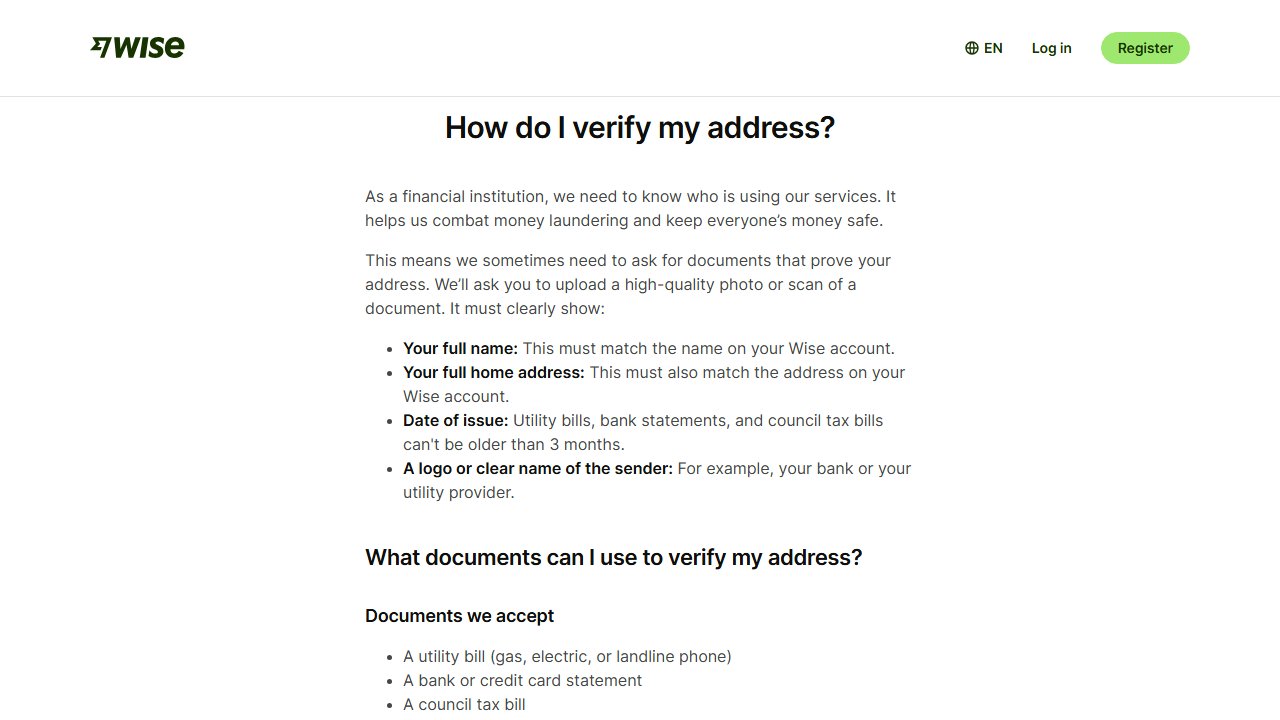
Wise publishes its accepted documents on a single help page, and it sets them out item by item. Its address-verification page names utility bills for gas, electricity or a landline phone; a bank or credit card statement; a council tax bill; a vehicle registration or tax document; a photo driving licence showing your address and expiry date; and a rental agreement.
The rental agreement carries the most conditions, and they are worth reading before you scan anything. Wise wants the document to show the address, your name, the landlord's name, the signatures of both parties, and the start and end dates of the tenancy. A one-page informal contract missing the landlord's signature does not meet the conditions set out on Wise's page.
Then there is the category that changes the picture for anyone who has not had paper post in two years. Wise also accepts other documents issued by a government body or a financial institution, and names N26, Monzo, Bunq and Monese as examples. In plain terms, one digital bank's statement can verify your address at another. If your mail is entirely electronic, that line is probably the most valuable sentence on the page.
Recency runs on three separate clocks, one per category of document. Utility bills, bank statements and council tax bills, in Wise's own words, "can't be older than 3 months". Documents issued by a Local Authority or an FCA-authorised institution are accepted within twelve months. A student acceptance letter falls back to the three-month window. Before you re-download anything, check which category your document falls into — a statement still inside its window does not need re-requesting.
The refusals that catch travellers first
Wise's page is equally specific about what it will not take, and the list reads like a description of how location-independent people actually live. Documents issued by Moneygram, WesternUnion or Revolut are not accepted. Mobile phone bills are not accepted. PO box addresses are not accepted. Documents in a company's name are out. A driving licence already submitted as your identity document cannot be reused as your address document. And Wise's own statements and transfer receipts do not count — the account cannot verify itself.
Two of those sting most: the phone-bill rule removes the one bill many long-term travellers still receive in their own name, and the PO box rule closes the tidiest-looking workaround. The Revolut exclusion surprises people too. We could not verify what Revolut itself accepts as proof of address in this version, so read that strictly as Wise's stated position on documents Revolut issues.
| Document | Wise | N26 (French page) |
|---|---|---|
| Mobile phone bill | Not accepted | Listed as valid |
| Landline / utility bill | Accepted, under 3 months | Accepted, under 3 months, or annual bill within a year |
| Rental contract | Accepted with names, signatures and dates | Accepted if under a year old |
| Another bank's statement | Accepted from a government body or financial institution | Not stated on the page we read |
| PO box address | Not accepted | Not stated on the page we read |
When no document has your name on it
This is the situation the whole search term is really about: you have been moving for eighteen months, you stay with a sibling between trips, and every bill at that address belongs to someone else. Wise publishes exactly one route for it, and it opens only when nothing at all is in your own name. Its page reads: "If you live with family or friends and don't have a document in your name, you can provide a document in their name along with a government-issued document confirming your relationship (like a birth certificate)."
Both halves are required. The household bill on its own proves the address exists and says nothing about you; the relationship document is what connects the two. Sending the household document without the relationship document leaves one of the two requirements on Wise's page unmet.
It is also worth knowing that this route is not universal. N26's French help page states that "Proof of accommodation is not considered as valid proof of address for opening an N26 account." An attestation d'hébergement is a familiar document to anyone who has dealt with French administration, and that sentence closes it off for account opening. Whether a given provider offers a household-document path at all is worth settling before you start collecting paperwork.
Why one bank's list does not travel
A caveat about the previous section that matters more than it looks. The N26 list we are quoting came from an English-language help page that returns the French market's document requirements. It is N26's guidance for France, not a pan-European standard, and we have not verified what the German, Spanish or Italian pages say. Do not carry these items across a border.
Within France, that page lists water, electricity, gas, TV, internet or landline bills under three months old — or an annual bill issued within the past year; a tax notice from the previous tax year; a housing document less than a year old; a rent receipt under three months old or a rental contract under a year old; home insurance issued within the past year; a current-year Mutuelle certificate; and a CAF document issued within the past year that includes housing benefit. Mobile bills from Orange, SFR, Bouygues and Free appear as valid, which is the direct opposite of Wise's rule.
That single contradiction is the practical lesson of this guide. There is no universal proof-of-address list, and the confident checklists circulating on nomad forums are usually one institution's policy, in one country, stripped of the label that would have made them useful. If you are choosing where to apply from abroad in the first place, our guide on opening an account as a non-resident covers the earlier decision, and the European banking overview covers who tends to ask for what.
What we could not verify in this version
Here is where this article stops as of 7 September 2026 — the questions we went looking for and could not settle from an official page:
- Payoneer's proof of residence requirements. Its official page did not return to us in this version, so we make no claim about its list or its time limits.
- What Revolut accepts. Also not verified in this version. The only Revolut fact here is Wise's stated position on documents Revolut issues.
- Virtual addresses and mail-forwarding services. Beyond Wise's line on PO boxes, we found no official statement from any provider about whether these are accepted, and we are not going to invent one.
- A registration country that no longer matches where you live. No provider we looked at publishes what happens in that case, so anyone telling you the consequence with confidence is not quoting a source.
- N26 outside France, and the guidance layer above all of this — EU anti-money-laundering directives, FATF recommendations, UK JMLSG guidance. Not checked here.
The folder worth building before anyone asks
- One statement from a second regulated provider, downloaded as the provider's own PDF and dated inside the last three months. Under Wise's rules this is the likeliest thing to work when no paper arrives for you.
- Your rental agreement in full, signature page and tenancy dates included. Partial scans are the quiet failure mode.
- The relationship document, if you use a family member's address — government-issued, not a letter you write yourself.
- A note of which page you read and when. These lists change. And if a review has already started, what to do when Wise freezes or closes your account covers the process side.
Frequently asked questions
Is proof of address a legal requirement?
Not in the way most people assume, at least not in the UK text. Regulation 28 of the Money Laundering Regulations 2017 requires a firm to identify an individual customer and verify that customer's identity. Read the regulation through and the word address turns up only at 28(3)(a)(iii), where it refers to the registered office of a body corporate. So there is no line in that regulation saying an individual must hand over a separate address document. What there is, at 28(18)(a), is a definition: to verify means to verify on the basis of documents or information obtained from a reliable source which is independent of the person whose identity is being verified. The document lists you meet at sign-up are each institution's own policy for meeting that standard, which is exactly why two providers can disagree about the same piece of paper.
Can I use another digital bank's statement as proof of address?
With Wise, yes, and its help page names the kind of provider it means. Alongside utility bills and council tax bills, Wise lists other documents issued by a government body or a financial institution, giving N26, Monzo, Bunq and Monese as examples. That is unusually useful if you have been travelling for a year and the only post arriving in your name is electronic. Two limits sit around it. Wise does not accept its own statements or transfer receipts for this purpose, so the account you are verifying cannot verify itself. And Wise groups documents issued by Moneygram, WesternUnion and Revolut among the sources it does not accept, so a statement from one of those will not stand in. What other providers accept from each other follows each provider's own policy, and we have not checked those here.
Why was my mobile phone bill rejected when a friend's was accepted?
Because you were probably applying to different institutions, possibly in different countries. Wise's address-verification page lists mobile phone bills among the documents it does not accept, while allowing a landline phone bill as a utility bill. N26's French help page goes the other way and names mobile phone bills from Orange, SFR, Bouygues and Free among valid documents. Both statements are current as far as we could see in September 2026, and they are not in conflict, because they are two separate policies. The practical consequence is that a checklist copied from a forum, or from a friend who opened an account somewhere else, is a poor guide. Read the accepted-documents page of the institution actually asking you, and read it in the market where your account sits.
Nothing is in my name because I stay with family. What can I send?
Wise publishes one route for this, and it opens only if you live with family or friends and don't have a document in your name. Its page says that in that case you can provide a document in their name along with a government-issued document confirming your relationship, giving a birth certificate as the example, and the two parts must arrive together. Sending only the household bill in someone else's name is the version that fails, because nothing then ties you to the address. Note that other institutions treat this situation differently. N26's French page states that Proof of accommodation is not considered as valid proof of address for opening an N26 account, so the attestation route familiar to French residents does not open that particular door. Before you gather anything, check whether the institution asking you publishes a route of this kind at all.
Sources read in September 2026: Wise's address-verification help page, N26's French-market help page on proof of address, and regulation 28 of the UK Money Laundering Regulations 2017. General information, not legal or financial advice. This page carries no promotional links; our affiliate arrangements elsewhere on the site are set out in the disclosure. Accepted documents and time limits differ by country, provider and account type and they change without notice, so confirm the current position on the provider's own page and take professional advice where your money or immigration position is at stake. See how we research and update our guides.
Section:Accounts & Paperwork